
Federal Releases Serving Bandera
No BOP institution was identified in Bandera County. A federal defendant may first appear in local custody, move under a federal court order, be held for the U.S. Marshals Service, and later enter BOP custody after sentence. Each move creates a different record. Bandera County Jail can document only its own book-out and destination.
A county entry stating transfer to a federal authority is not community release. It shows that Bandera custody ended. The receiving federal agency and court docket must establish what followed. Conversely, a BOP release record does not prove what happened during an earlier Bandera booking unless identifiers and the federal case connect the two.
Search BOP Release Records
The BOP Inmate Locator is the official federal-prison search. It covers federal prisoners incarcerated from 1982 to the present and many people released after 1982. Older federal prison material may require the National Archives.
- Search by BOP Register, DCDC, FBI, or INS number when available.
- Otherwise enter first, middle, and last name, then narrow by age, race, and sex.
- Match the register number and identity fields before reading status.
- Record the location, release date, and exact status displayed.
- Compare the result with the federal docket and any Bandera transfer entry.
BOP states that locator data comes from its primary database and updates daily. Daily updating does not make every future date final or turn the locator into a county-jail release feed.
Read Federal Release Status
A past date paired with “Released” means the BOP custody reflected by the locator ended on that date. It does not by itself end supervised release, an immigration hold, a state detainer, or custody held by another agency. A federal judgment and supervision record resolve those questions.
| Locator display | Careful meaning |
|---|---|
| Released with past date | BOP custody shown by the locator ended on that date. |
| Future release date | A projection that can change with sentence-credit calculations or case events. |
| Unknown | The confinement term may not yet be determined, including some pretrial or unsentenced cases. |
| Not found | No matching locator record; it is not proof of community release. |
| Facility location | The BOP location reported for the matched person. |
Read the words literally. “Not in BOP custody” is broader than “free.” A person might remain in local, state, USMS, immigration, or community-confinement custody.
Bandera Federal Transfer Proof
Call Bandera County Jail at 830-796-7759 when the search begins with a local booking. Request the actual book-out time, release or transfer type, authority, destination, and receiving agency. Use the full name, date of birth if known, booking number, and approximate transfer date.
If telephone confirmation is not enough, use the Bandera County public-information route. Ask for existing fields rather than a custom explanation. The county record answers when Bandera stopped holding the person. It cannot establish later federal release.
USMS Custody Before BOP
The U.S. Marshals Service prisoner program handles many people held under federal court authority from remand through acquittal, release, or delivery to BOP after conviction. USMS does not operate its own detention facilities. It may use federal, state, local, or private beds.
No nationwide USMS historical release locator comparable to BOP’s was found. For a pretrial or unsentenced person, use the federal court order, actual holding facility, and USMS record. A BOP search can be blank because the person never entered BOP custody, not because the person was released.
Request Federal Custody Records
A USMS Freedom of Information Act request can seek identifiable existing records. The agency says no special form or initial submission fee is required, although later fees, exemptions, and redactions may apply. Include the person’s full identity, federal case number, date range, requested record type, and preferred format.
USMS need not research a broad question, analyze information, or create a record. Ask for a custody or transfer record by date and case. For BOP, provide the register number and identify the release or incarceration record sought. The federal docket remains the best source for the judgment and court-ordered supervision.
Federal Docket Explains Release
The court docket can show detention orders, bond, judgment, sentence, amended orders, and supervised-release terms. Those entries explain legal authority. They do not always show the physical gate time, so pair them with the holding agency’s custody record.
- Pretrial detention
- Custody before final disposition of the federal charge.
- Community confinement
- A structured placement that may remain part of federal custody.
- Supervised release
- Court-ordered federal supervision after imprisonment.
- Detainer
- A request or basis for another authority to assume or continue custody.
Supervised release is not Texas parole. Its conditions arise from the federal judgment and are administered through the federal court system.
Federal Locator Source View
The official BOP locator provides the federal name and identifier search.
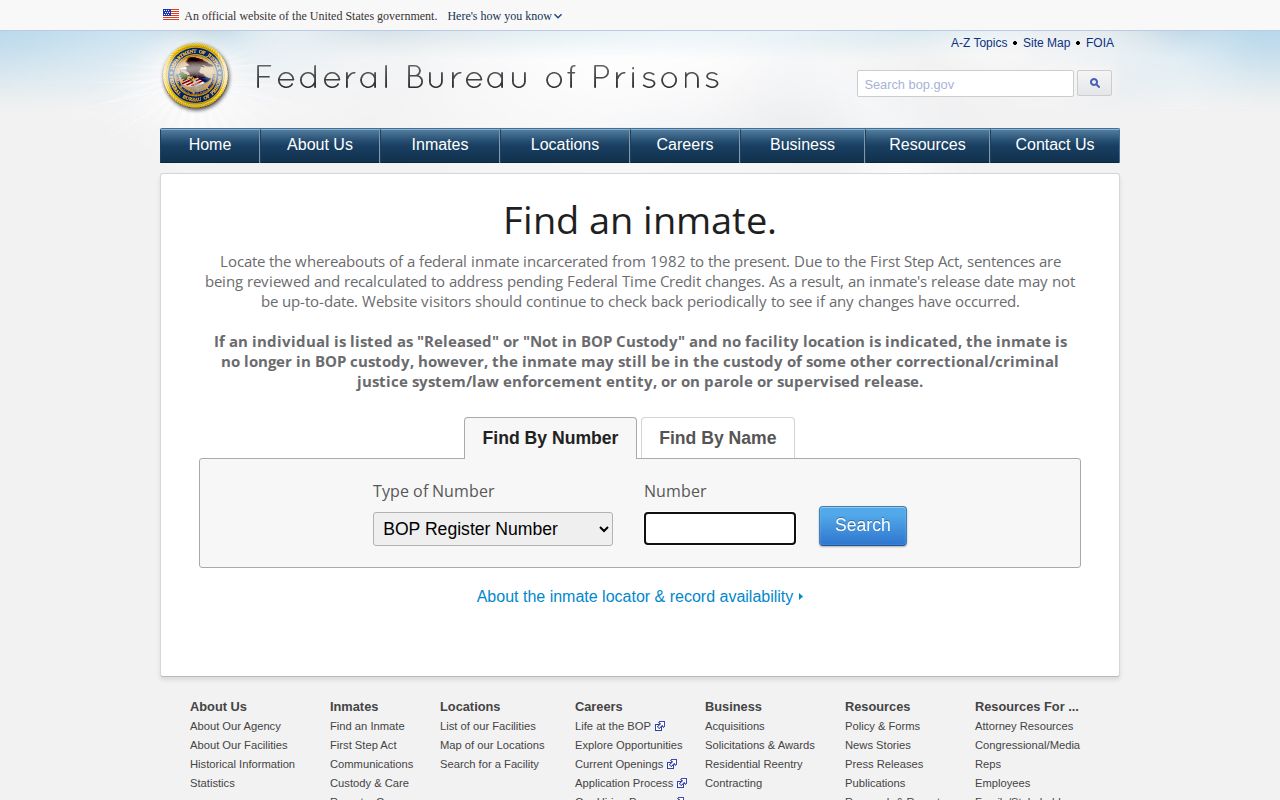
The captured interface belongs to the federal system. It should not be described as a Bandera County roster or used to infer that a missing person left all custody.
Federal Custody Crosswalk
Start with the agency that last held the person. Bandera’s jail record proves the local exit and named destination. USMS and the holding facility cover federal pretrial custody. BOP covers federal imprisonment and some historic released results. The federal court covers legal disposition and supervision.
If ICE or a state agency assumed custody after BOP, the federal “Released” result still remains accurate within its limited scope. Follow the receiving authority. A negative search is never enough to close the inquiry.
Confirm Completed Federal Release
A defensible confirmation combines matching identifiers, a past BOP release date when applicable, the federal docket, and any receiving-agency record. Preserve the locator result and retrieval date because statuses and projected dates can change.
For a Bandera-linked case, also retain the county booking or transfer entry. That creates a chain from local custody to federal authority and, later, the recorded end of BOP custody. Personal verification, notification, reconnecting, and court or legal processes are appropriate reasons to follow this chain.
Federal Records Contact Path
There is no local BOP address to list because no BOP facility in Bandera County was identified. Use the locator to identify the institution or release result, then contact the responsible federal office. For a local starting point, Bandera County Jail is at 3360 State Highway 173 North, Bandera, Texas 78003, with jail information at 830-796-7759.
Before visiting any holding site, confirm the operator, current location, and visiting or records rules directly. Federal detainees can be housed under contract far from the court or county connected to the case.
Match Federal Identifiers Carefully
A name search can return more than one person. The BOP Register number is the strongest locator key when known. DCDC, FBI, and INS numbers can also be used in the identifier search. When only a name is available, compare the middle name, age, race, sex, location, and federal case details before accepting a match.
A Bandera booking number is not a BOP Register number. Preserve both and connect them through the county transfer record or federal docket. If the county record names USMS rather than BOP, do not assume the person reached a federal prison. Pretrial release, dismissal, acquittal, plea, sentence, or transfer can change the path before BOP admission.
Distinguish Federal Release Stages
Federal custody can move through several stages. A court may release a defendant on conditions before trial. USMS may hold a detained defendant in a contract facility. After conviction, USMS can deliver the person to BOP. Near the end of a sentence, BOP may use community confinement before the recorded term ends. Later, the court can require supervised release.
These stages should not be compressed into one “release date.” The BOP locator date concerns the federal imprisonment record it displays. A court order supplies pretrial or supervised-release terms. A holding facility records the physical exit. When another detainer exists, the person can move directly into new custody.
Older Federal Release History
BOP describes locator coverage as federal prisoners incarcerated from 1982 forward and released federal prisoners after 1982. Historical records outside that span may be held by the National Archives. An absent older record therefore reflects coverage limits rather than proof that the federal sentence or release never occurred.
For a modern case with a missing result, verify spelling and identifiers, then inspect the docket. The person might have remained in USMS custody, served time credited in another facility, or never entered BOP. Ask the agency holding the relevant records rather than repeating the same locator query.
Preserve Federal Release Evidence
Save the matched locator result with the access date, register number, displayed status, date, and location. Obtain the judgment and any later supervision or detention order from the federal court. For a Bandera origin, add the county book-out and destination fields.
This chain answers three separate questions: when Bandera custody ended, whether federal imprisonment followed, and when BOP custody ended. If another agency accepted custody, continue the chain with that agency’s record. No single status should be stretched beyond the system that produced it.
Public Record Search
Sponsored Results